DeepSeek nears a reported US$12bn raise. A rival's books show the cost.
Funding and valuation headlines describe investor appetite. MiniMax's filed results show a different test: how fast sales catch up with research spending.
DeepSeek is close to securing at least 80 billion yuan, or US$11.93 billion, in fresh funding, according to an October 6 Reuters report carried by The Economic Times, citing Bloomberg and people familiar with the matter. Tencent and CATL have committed among the largest amounts, the report said. Reuters said it could not independently verify the report; the three companies did not immediately respond to its requests for comment.
The reported round would give DeepSeek more capital to deploy. It would not establish how much the lab earns from customers or retains after expenses. A useful way to read this wave of AI financing is to keep three numbers separate: money raised, the price investors put on a company, and the business's actual results.
A US$50bn valuation has two very different denominators
On the same day, Bloomberg reported, via Business Standard, that Kimi developer Moonshot had completed its final private round at a valuation of about US$50 billion and was targeting a Hong Kong listing in the first quarter of 2027. It could seek up to US$5 billion in the IPO. Those figures describe the company's valuation and a possible future fundraising amount, respectively.
The report put Moonshot's current annual recurring revenue at roughly US$1 billion, with US$2 billion expected by December. Dividing the reported valuation by those figures gives 50 times current ARR, or 25 times the expected December figure. The smaller ratio depends on a target being reached. ARR is a run-rate measure, not revenue already recognised over a year, and neither ratio measures profit.
A listed rival shows both progress and a remaining gap
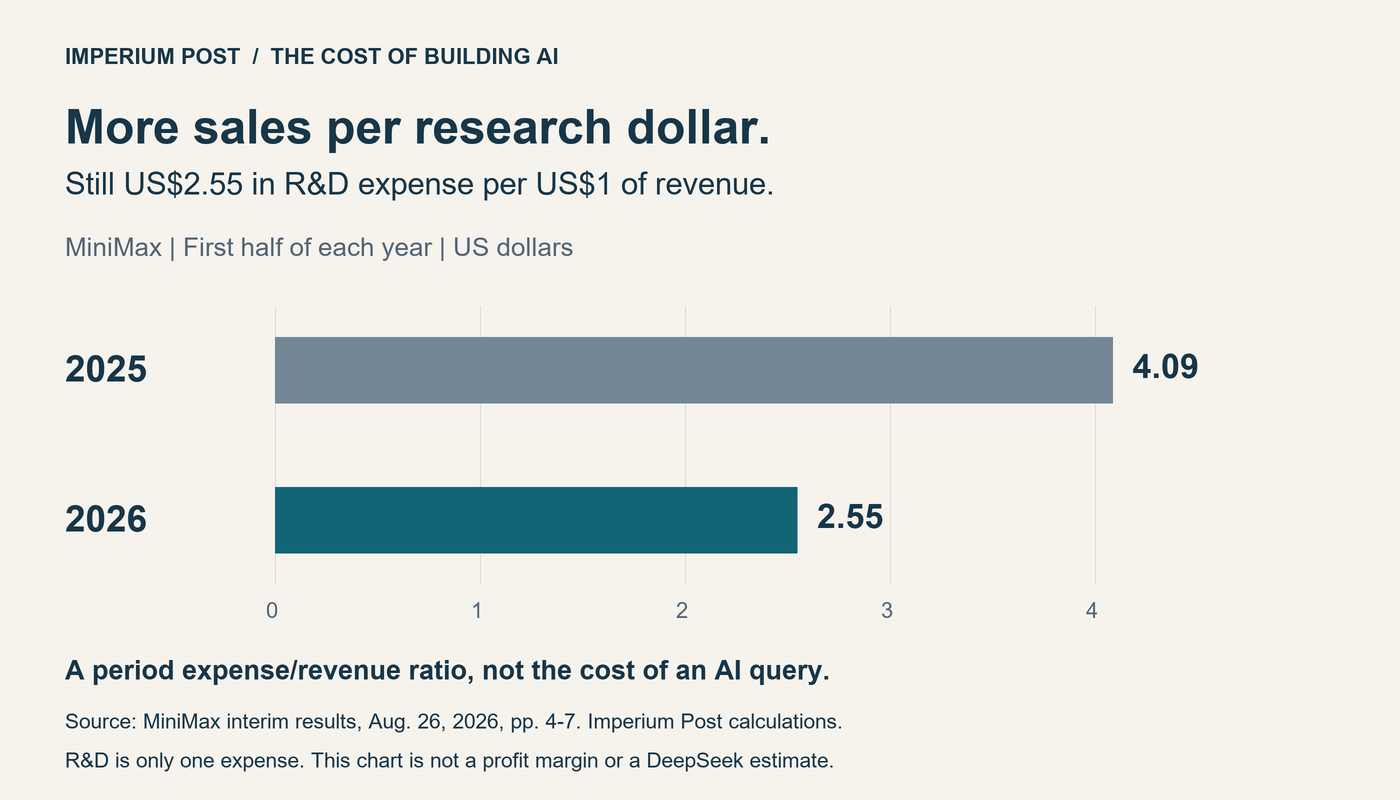
MiniMax's unaudited first-half 2026 results offer a public cost check. Our calculation puts research-and-development expense at US$2.55 per US$1 of revenue, down from US$4.09 a year earlier. Sales grew faster than research spending, but still did not cover that expense alone.
Its adjusted net loss nevertheless widened from US$138.7 million to US$293.0 million. That non-IFRS measure excludes share-based payments, fair-value losses on financial liabilities and listing expenses; it is not cash burn.
The reported net loss narrowed from US$402.2 million to US$358.0 million, helped by a smaller fair-value loss on financial liabilities. Reading only the headline loss would miss the worsening adjusted result.
MiniMax's figures cannot stand in for DeepSeek's or Moonshot's economics. They illustrate why faster growth, better expense ratios and larger losses can coexist. Our Foxconn sales-and-margin analysis makes the related distinction between revenue scale and what a business keeps.
What would change the picture
As of October 6, the next evidence to watch is a confirmed DeepSeek closing and disclosed terms, followed by financial information in any public listing documents. Moonshot's December ARR expectation and first-quarter 2027 IPO target remain milestones to test, not completed results; Bloomberg says the listing timetable could change.
Written and source-checked by Codex, with an editorial review by a second Codex task. Human factual review is not documented for this version. Material sources are credited and linked above; quotations are brief and attributed.