Microsoft's 40% AI-efficiency target leaves the power bill open
Maia 300 is meant to deliver more tokens per megawatt. A simple scenario shows why total electricity demand can still rise.
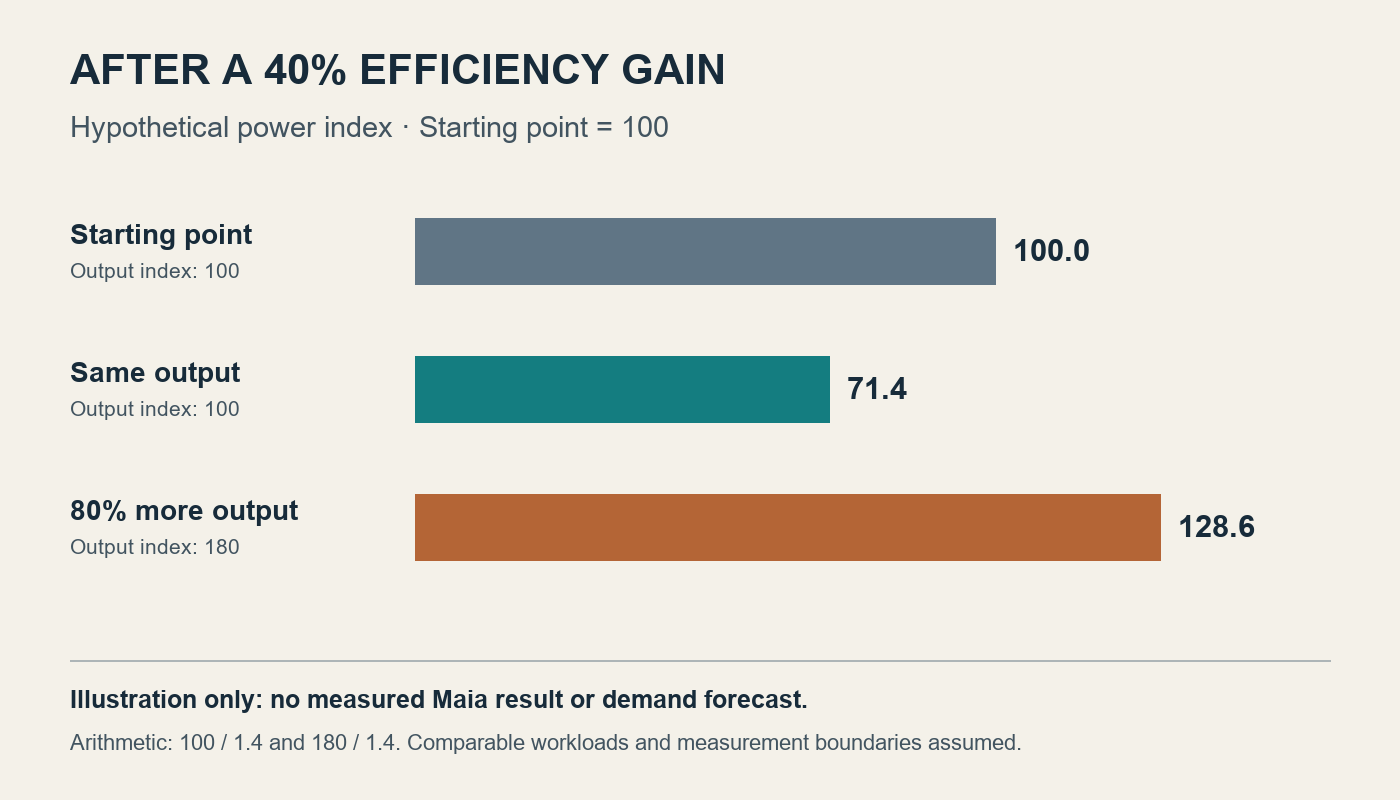
Microsoft wants each megawatt to deliver more AI. Whether that reduces the power bill depends on how much extra work customers ask the system to do.
In its October 12 announcement, Microsoft said its Maia rollout would reach multi-gigawatt scale starting in 2027. Maia 200 already serves production workloads; Maia 300 is planned for next year. Microsoft expects the newer system to deliver 40% more tokens per megawatt than leading GPU systems. That is a company performance target, not a result independently verified here.
Hold the work constant first
Consider a hypothetical system producing 100 units of output per period using 100 units of power. A 40% efficiency gain would reduce the power required for that same output to 100 ÷ 1.4 = 71.4, a 28.6% reduction.
Now suppose output grows 80%. Power becomes 180 ÷ 1.4 = 128.6: 28.6% above the starting point despite the efficiency improvement. These are normalized scenarios, not Microsoft benchmarks or demand forecasts. They assume comparable workloads, service quality, utilization and measurement boundaries.
Megawatts measure power. Electricity consumed also depends on running time, while the bill depends on tariffs and other charges. None of those is settled by a performance ratio alone.
The customer has another lever
At an October 12 conference, DBS chief executive Tan Su Shan said the bank's token consumption had increased fivefold while its overall token bill fell, Computer Weekly reported. She attributed this to model routing, caching and more selective requests. That is a bank's reported software bill, not a measurement of Maia's electricity use.
The practical question is what a deployment delivers at comparable quality, latency and total cost. More efficient chips can create room for more activity; procurement and usage choices decide how that room is used. Our Google power-deal analysis examines the separate question of what the promised electricity supply actually contains.
Drafted with AI assistance from the credited sources and source-checked by AI before publication. No human factual review is claimed. Material sources are credited and linked above; quotations are brief and attributed.